
"If You Don't Know What You Own, You Can't Know What to Expect."
Oil and gas investing isn't a single category. Unlike stocks or bonds, where your ownership is straightforward, energy investments involve layered property rights — and the way you own your interest determines everything: from income and control to risk, costs, and tax treatment.
This guide breaks down the four primary ownership structures used by accredited investors in private energy: Working Interest, Royalty Interest, Mineral Interest, and Overriding Royalty Interest (ORRI). Understanding each is foundational to evaluating any energy deal.
Why Ownership Structure Matters
Each ownership type answers three critical questions differently:
- →Who pays for the costs of drilling and operating?
- →Who shares in the revenue when production flows?
- →What tax benefits are available to this type of owner?
Before comparing structures, understand the core terminology: Gross Revenue Interest (GRI) is your share of total well revenue before costs; Net Revenue Interest (NRI) is your share after royalties are deducted from the working interest. Working interest owners receive NRI; royalty owners receive a fixed GRI.
Working Interest (WI)
The Working Interest is the most active form of energy ownership. Working interest owners participate directly in the development and operation of a well — and bear the costs of doing so.
Revenue
Proportional share of production proceeds, after royalties are paid to non-cost-bearing owners.
Costs
Proportional share of all drilling, completion, and operating expenses.
Tax Treatment
Qualifies for Intangible Drilling Cost (IDC) deductions (often 60–80% of cost deductible in Year 1), equipment depreciation, and depletion.
Control
Can influence or participate in operator decisions, depending on the partnership agreement.
Example: If you own a 10% Working Interest in a well generating $500K/year in gross revenue, and royalties total 20% ($100K), you receive 10% × $400K NRI = $40,000/year — but also pay 10% of all operating costs.
Ideal For:
Tax-motivated investors seeking large first-year deductions, or experienced investors who understand operational exposure and want direct upside in well performance.
Royalty Interest (RI)
A Royalty Interest is a passive, cost-free ownership stake in production revenue. Royalty owners never bear the cost of drilling or operations — they simply receive a percentage of what comes out of the ground.
Revenue
Fixed percentage of gross production revenue (e.g., 12.5–25% of all oil and gas sold).
Costs
None — royalty owners bear no operational expenses.
Tax Treatment
Qualifies for Depletion Allowance (15% annual deduction on gross income). Does not qualify for IDCs.
Control
Minimal. Royalty owners have no say in operational decisions.
Ideal For:
Income-oriented investors seeking consistent, cost-free cash flow from producing properties — often used by retirees, family trusts, or estate portfolios.
Mineral Interest (MI)
Mineral Interest represents ownership of the subsurface minerals beneath a tract of land — the most foundational form of energy ownership. Mineral owners can lease their rights to operators, collect royalties, or participate in development.
Revenue
Royalty income from production leases; also receives bonus payments when land is initially leased.
Costs
None during production — costs are borne by the lessee/operator.
Tax Treatment
Depletion allowance applies. Lease bonuses may be treated as ordinary income or capital gains depending on circumstances.
Perpetuity
Mineral rights are perpetual — they can be passed to heirs indefinitely.
Ideal For:
Legacy investors, land-wealthy families, or estate planners who want permanent, generational energy assets with no operational responsibilities.
Overriding Royalty Interest (ORRI)
An Overriding Royalty Interest is a cost-free interest carved out of the lessee's Working Interest. Unlike Mineral Interest, ORRI is tied to the life of the lease — it terminates when the lease expires or is abandoned.
Revenue
Fixed percentage of production, taken from the lessee's WI (not from the mineral owner's share).
Costs
None — ORRI owners are not responsible for operational expenses.
Duration
Tied to the lease term — expires when the lease ends.
Tax Treatment
Depletion allowance applies. Generally treated as ordinary income.
Common Use Cases:
ORRIs are often granted to landmen, geologists, or deal finders who contributed to leasing activity. They may also be created by operators as a way to compensate partners without sharing working-interest ownership.
Side-by-Side Comparison
| Feature | Working Interest | Royalty Interest | Mineral Interest | ORRI |
|---|---|---|---|---|
| Costs Borne | Yes | No | No | No |
| Pays Royalties To Others | Yes | No | Leased to operators | No |
| Receives Royalties | No (net after costs) | Yes (gross %) | Yes (lease royalty) | Yes (gross %) |
| IDC Tax Deductions | Yes | No | No | No |
| Depletion Allowance | Yes | Yes | Yes | Yes |
| Permanent Ownership | Per lease/program | Per lease | Perpetual | Per lease term |
| Operational Control | Potential | None | Through leasing | None |
| Income Type | Active (if WI) | Passive | Passive | Passive |
Energy Ownership Stack
How interests are layered — from mineral ownership down to working interest
How Money Flows from Wellhead to Investor
Production Revenue
Oil and gas sold at market price. Gross revenue is established.
Royalties Deducted
Mineral and royalty owners receive their fixed percentage off the top.
Operating Expenses
Lease operating expenses (LOE) are deducted from the working interest share.
Net Distribution
Remaining revenue is distributed to working interest owners proportional to their NRI.
U.S. Shale Plays & Producing Basins
Lower 48 states — major tight oil and shale gas plays.
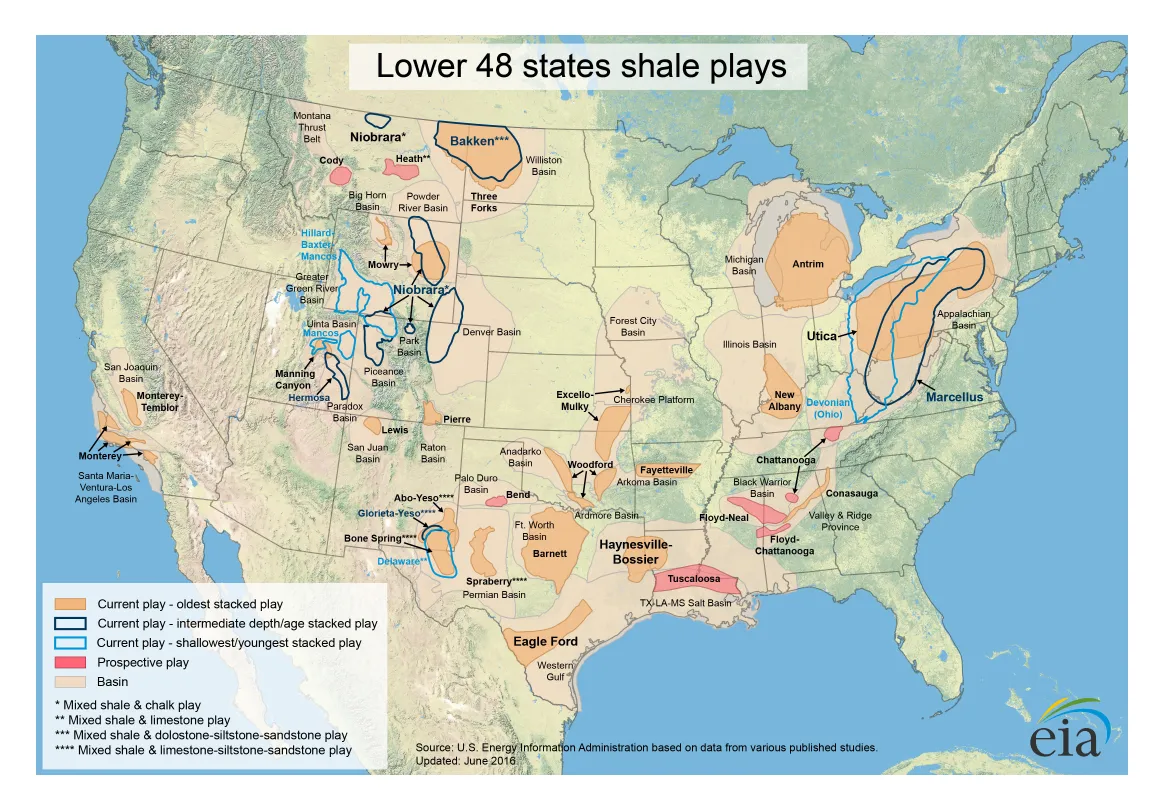
Source: U.S. Energy Information Administration (EIA). For educational purposes only.
Choosing the Right Structure for Your Goals
| Investor Goal | Best Structure |
|---|---|
| Maximize first-year tax deductions | Working Interest |
| Steady, cost-free monthly income | Royalty Interest |
| Long-term, generational wealth | Mineral Interest |
| Income participation without operational exposure | ORRI |
| Education before committing to structure | Start with HG Energy's programs |
HG Energy Insight: Most accredited investors begin their energy journey with education and relationship-building before selecting a structure. Our accelerator program helps investors understand these distinctions deeply before making any commitments.
✓ Key Takeaways
- ✓Working Interest owners participate in costs and receive the highest potential returns — and the most significant tax advantages.
- ✓Royalty and Mineral Interest owners receive cost-free income, but don't qualify for IDC deductions.
- ✓ORRI is a temporary, lease-tied interest — valuable for income but not permanent.
- ✓Your ownership type determines your income, tax situation, control, and risk exposure.
- ✓Always understand what you own before evaluating a deal — structure is the foundation of every energy investment.